
risk and compliance
Govern more, review less
Connect policies, workflows, and signals across systems to detect risk, enforce controls, and maintain audit-ready operations with the Uniphore Business AI Cloud.
THE CHALLENGE
Risk and compliance demands are growing. Manual oversight does not scale the same way.

Monitoring depends on manual review and fragmented oversight, typically reviewing less than 5% of interactions

Risk signals are spread across systems, interactions, documents, and financial records

Controls are applied inconsistently across workflows and teams

Audit and regulatory reporting depend on reconstructing what happened after the fact
The Uniphore Business AI Cloud Changes That
The Uniphore Business AI Cloud enables organizations to move from manual oversight to continuous, governed risk and compliance execution.
It works across existing systems, communications, and workflows to connect policies, signals, and actions into a coordinated and auditable flow of execution.
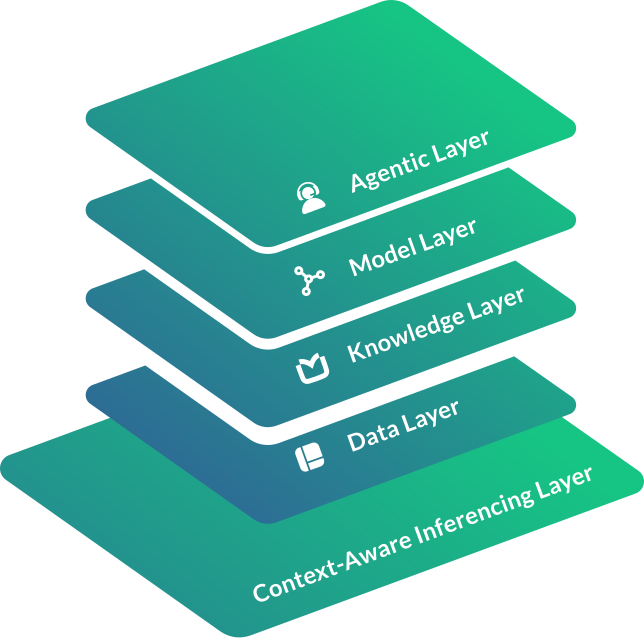
- Agentic layer — Autonomous agents that execute and enforce financial workflows
- Model layer — Intelligence that detects risk, anomalies, and policy violations
- Knowledge layer — Encoded policies, controls, and compliance frameworks
- Data layer — Unified operational data across systems, documents, and workflows
70-80%
automation of compliance checks and documentation
50%
decrease manual KYC effort and associated costs
HOW IT WORKS
Align risk detection, policy enforcement, and auditability across workflows
01
See risk and compliance signals
Capture signals across systems, communications, documents, workflows, and interactions.


02
Understand obligations and exposure
Identify how work is performed, where controls break down, and where risk is emerging.
03
Apply policies and controls during execution
Ensure reviews, approvals, validations, and escalations follow defined requirements.
04
Execute workflows with AI agents
Coordinate actions across systems, from document review and compliance monitoring to exception handling and follow-up.
05
Maintain audit-ready records
Generate clear, verifiable records of decisions, validations, actions, and outcomes.
OUTCOMES
Compliance operations with greater coverage, speed, and control

Expand oversight without scaling manual review effort.

Detect policy deviations and emerging risks early.

Improve consistency in how controls are applied.

Reduce effort across monitoring, review, and reporting workflows.

Strengthen audit readiness with clear traceability across actions and decisions.
KEY USE CASES
Governed compliance automation across your highest-exposure workflows

Compliance monitoring and alerting
Ensure requests follow defined processes with policies applied during execution

Document review and validation
Accelerate high-volume reviews across lending, onboarding, and KYC with AI-assisted validation that is explainable and audit-ready

Contract and obligation compliance
Validate invoices, clauses, and obligations against approved standards to surface non-compliance before payment is executed

Exception handling and escalation
Route exceptions, flag elevated-risk cases, and coordinate follow-up with full documentation of every escalation

Audit and regulatory reporting
Maintain verifiable records across decisions, approvals, and outcomes — assembled on demand for audit or regulatory examination
WHY UNIPHORE
Agentic AI for your GRC program
Uniphore does not replace your systems of record. It brings governed execution to how risk and compliance work is carried out across them.
- Coordinate workflows across systems, data, documents, and teams
- Apply policies and controls during execution
- Reduce reliance on manual review in high-volume environments
- Improve explainability, auditability, and traceability across compliance operations
FAQ
Continuous compliance monitoring means reviewing risk signals, policy adherence, and control execution in real time — across all activity, not just a sampled subset. Unlike periodic audits that look backward, continuous monitoring detects deviations as they happen, giving compliance teams the opportunity to intervene before issues escalate. This shift from reactive to proactive oversight is important as regulators expect organizations to show that controls are applied consistently, not just documented.
AI improves compliance monitoring by helping teams review faster — analyzing interactions, documents, workflows, and transactions continuously against encoded policies and control frameworks. AI models identify deviations, anomalies, and emerging risk patterns in real time, while AI agents route exceptions, trigger escalations, and document every action taken. The result is broader oversight with less manual effort and a more consistent application of controls across teams and systems.
AI accelerates KYC and lending document review by automatically validating documents against defined requirements, flagging incomplete or non-compliant submissions, and prioritizing cases that require human review. Rather than reviewers working through every document manually, AI handles the high-volume, rules-based validation work and surfaces only the exceptions that need judgment. Every validation step is logged, making the process explainable and audit-ready without additional documentation effort.
The Uniphore Business AI Cloud maintains verifiable records of every decision, validation, escalation, and outcome across compliance workflows — assembled continuously rather than compiled at reporting time. When an audit or regulatory examination requires evidence, teams can pull complete traceability across any workflow without manual reconstruction. This reduces the time and effort involved in audit response and reduces the risk of gaps or inconsistencies in the record.
Uniphore does not replace your existing systems of record or GRC platforms — it works across them. The Business AI Cloud connects to your current systems, documents, and workflows, applying AI-driven monitoring, policy enforcement, and governed execution on top of your existing infrastructure. Compliance teams gain expanded coverage and auditability without migrating platforms or rebuilding control frameworks from scratch.
Reduce manual review. Strengthen compliance oversight.
See how Uniphore’s Business AI Cloud gives your compliance team full visibility, faster response, and audit-ready evidence starting from day one.